

It figures–I finally get fenders on my bike and make myself a rain jacket, and the weather’s as dry as a bone.
I haven’t had a chance to test just how waterproof my new jacket is, but I thought I’d share some thoughts about sewing with silkara.
What is Silkara?
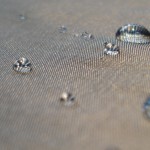
Silkara is a crisp nylon/poly fabric with a DWR (Durable Water Repellent) finish, which means it’s water resistant. It actually looks a bit like silk dupioni without the slubs, because the warp thread is one color nylon while the weft is a second color polyester. That gives it a lovely iridescence. I got mine at Seattle Fabrics, where they’ve got a nice selection of colors.
I haven’t been able to find a ton of information on the interwebs about Silkara, so I thought I’d put a post up with my field notes on sewing with it.
Cutting: When you’re laying out your pieces to cut, think about silkara like you would think about velvet, or anything with a nap. Because of the weft and warp threads being different colors, the shade of the fabric changes depending on how light is hitting it. That means it’s important to lay out your pattern pieces all facing the same direction. If, for example, you cut one panel one way and one the other, they’ll look like two different shades when they’re sewn next to each other.
Frontside vs. Backside: I had a hell of a time trying to figure out which was the front and the back side of the fabric. For that reason, I highly recommend using a piece of masking tape (or some other system) to mark the front. That’ll save you a lot of head-scratching down the road.
Pinning: I didn’t notice much of a problem with pins leaving holes in the fabric, but I tried to only pin inside the seam allowance just to be on the safe side. There’s not much point in a water resistant fabric that’s got a bunch of holes punched through it.
Silkara is slippery, though, so although I don’t pin much as a rule, I found I did have to pin almost all my seams on the Minoru jacket.
Needles: Use the smallest, sharpest needles you have. I used size 10 universal needles, and I felt like it was still a bit brutish. From reading through this great resource on different types of needles, I think I should have been using Microtex needles. I’m not great about using the correct types of needles—I normally just use universals and call it good. That’s one of my sewing resolutions.
Interfacing: Doesn’t stick. I tried to get the fusible stuff to bond, but after moving each piece around a bit, the interfacing just worked itself right back off. I ended up just treating my interfacing as though it were sew-in, and the cuffs/collar/front placket all have an acceptable level of stiffness, so I’m okay with it.
Ironing: Low, low, low. Because Silkara is 50% nylon, you need to keep your iron on the lowest setting you can, and use a pressing cloth. I tried not to as much as possible, but there were a couple times (like hemming) that it was necessary. If you’re top stitching your seams it still looks pretty good.
So, how do you care for silkara ultrex?
Like any fabric with a DWR finish, the finish will wear off over time and with washing. I called Seattle Fabrics to ask how they recommend caring for it. They say not wash it with detergent, and recommend washing with Nikwax.
As for my Minoru, because it’s lined with rayon, I don’t think I’d wash it in Nikwax. Rather, I plan to wash with a detergent-less laundry soap, then use a Nikwax spray to re-up my waterproofness.
Does anyone have any tips to add? About sewing with Silkara, or any other DWR fabrics? Leave ’em in the comments!




Hi Jessie – thanks for this. I’ve got a hideous raincoat I’ve been planning to replace for years and I finally got the bug to order some fabric. I appreciate the tips on Silkara as I’m about to place my order at Seattle Fabrics right now! Since we’re finally getting some much needed rain in the Bay Area this year, I hope to get a lot of use out of my new jacket. Wish me speedy sewing :-).
Hi Susan & Jessie,
I have been sewing doggy jackets for 7 years now with the Silkara fabric from Seattle fabrics, which you may think … “what she lives in Canada”, but I actually was living in Fort McMurray, Alberta, Canada at the time trying to find a nice soft but tough water repellant fabric to use to make my Bichon dogs winter jackets & boots…. Seattle fabrics sent me samples to start and a number of creations have happened since.
Maureen